
HPE ProCurve 8212 zl Managed L3 Power over Ethernet [PoE]
MPN: Quick Code:
(HP E8212 v2 zl Swch w Premium SW)
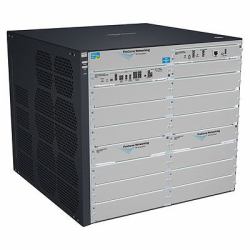
Note: Image accuracy is not guaranteed. Please do not rely solely on the image for your purchase.
$8255.66 $9906.79 inc. VAT
Check stock Available
All products on this website are available duty-free in the EU
Overseas Customers with EU-VAT number do not pay VAT. -
- Quick Code:
- MPN:
- Manufacturer:
- HPE
- EAN Code:
Notify me when price drops
NOTE: The information below is provided for your convenience only and we cannot guarantee its accuracy. If necessary, please verify with us before purchasing.
OpenFlow: is a key technology enabling software-defined networking by allowing the separation of data (packet forwarding) and control (routing decision) paths.
- Advanced classifier-based QoS: classifies traffic using multiple match criteria based on Layer 2, 3, and 4 information; applies QoS policies such as setting priority level and rate limit to selected traffic on a per-port or per-VLAN basis.
- Layer 4 prioritization: enables prioritization based on TCP/UDP port numbers.
- Traffic prioritization: allows real-time traffic classification into eight priority levels mapped to eight queues.
- Bandwidth shaping: Port-based rate limiting: provides per-port ingress-/egress-enforced maximum bandwidth. Classifier-based rate limiting: uses an access control list (ACL) to enforce maximum bandwidth for ingress traffic on each port. Guaranteed minimum: provides per-port, per-queue egress-based guaranteed minimum bandwidth.
- Class of Service (CoS): sets the IEEE 802.1p priority tag based on IP address, IP Type of Service (ToS), Layer 3 protocol, TCP/UDP port number, source port, and DiffServ.
HP AllianceONE Services zl Module: allows you to embed applications directly into the network, either distributed throughout the network at the network edge, or centralized in the core or distribution layer; for more information about the HP AllianceONE solution, visit the HP website.
- Remote intelligent mirroring: mirrors selected ingress/egress traffic based on ACL, port, MAC address, or VLAN to a local or remote HP 8200 zl, 6600, 6200 yl, 5400 zl, or 3500 Switch anywhere on the network.
- RMON, XRMON, and sFlow v5: provide advanced monitoring and reporting capabilities for statistics, history, alarms, and events.
- IEEE 802.1AB Link Layer Discovery Protocol (LLDP): automated device discovery protocol provides easy mapping of network management applications.
- Uni-Directional Link Detection (UDLD): monitors a cable between two switches and shuts down the ports on both ends if the cable is broken, turning the bidirectional link into a unidirectional one; this prevents network problems such as loops.
- HP unified core-to-edge device/network management tools: provide HP networking portfolio-common device-level tools (CLI, Web GUI, and Menu) plus seamless integration into HP PCM+/Identity Driven Manager (IDM) network management deployments.
- High-density port connectivity: provides 12 interface module slots, up to 288 wire-speed 10/100/1000 PoE-enabled ports, or 96 10-GbE ports per system.
- IEEE 802.3az Energy Efficient Ethernet: lowers power consumption in periods of low-link usage (supported on v2 zl 10/100/1000 and 10/100 modules).
- IEEE 802.3af Power over Ethernet (PoE): provides up to 15.4 W per port to IEEE 802.3af-compliant PoE-powered devices such as IP phones, wireless access points, and security cameras.
- IEEE 802.3at Power Over Ethernet Plus: provides up to 30 W per port to IEEE 802.3 for PoE-/PoE+-powered devices such as video IP phones, IEEE 802.11n wireless access points, and advanced pan/zoom/tilt security cameras.
- Jumbo frames: on Gigabit Ethernet and 10-Gigabit ports, jumbo frames allow high-performance remote backup and disaster-recovery services.
- High-speed, high-capacity architecture: 1.12 Tbps crossbar switching fabric provides intra- and inter-module switching with 739.2 million pps throughput on the purpose-built HP ProVision ASICs.
- Selectable queue configurations: allows for increased performance by selecting the number of queues and associated memory buffering that best meet the requirements of the network applications.
- Scalable system design: chassis architecture/backplane provides built-in performance capacity/headroom to support next-generation high-density/high-speed connectivity.
- Nonstop switching: improves network availability to better support critical applications such as unified communication and mobility; interface and fabric modules continue switching traffic during failover from active to standby management module.
- Nonstop routing: enhances Layer 3 high availability; OSPFv2/v3 and VRRP will continue to operate and route network traffic during failover from an active to a standby management module.
- Redundant management, fabric, and power: provide enhanced system availability and continuity of operations.
- Distributed trunking: enables loop-free and redundant network topology without using Spanning Tree Protocol; allows a server or switch to connect to two switches using one logical trunk for redundancy and load sharing.
- IEEE 802.1s Multiple Spanning Tree Protocol: provides high link availability in multiple VLAN environments by allowing multiple spanning trees; encompasses IEEE 802.1D Spanning Tree Protocol and IEEE 802.1w Rapid Spanning Tree Protocol.