NOTE: The information below is provided for your convenience only and we cannot guarantee its accuracy. If necessary, please verify with us before purchasing.
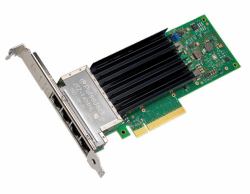
Intel X710-T4L Internal Ethernet 10000 Mbit/sIntel Ethernet Network Adapter X710T4L
iWARP/RDMAiWARP delivers converged, low-latency fabric services to data centers through Remote Direct Memory Access (RDMA) over Ethernet. The key iWARP components that deliver low-latency are Kernel Bypass, Direct Data Placement, and Transport Acceleration.
Intel® Data Direct I/O TechnologyIntel® Data Direct I/O Technology is a platform technology that improves I/O data processing efficiency for data delivery and data consumption from I/O devices. With Intel DDIO, Intel® Server Adapters and controllers talk directly to the processor cache without a detour via system memory, reducing latency, increasing system I/O bandwidth, and reducing power consumption.
PCI-SIG* SR-IOV CapableSingle-Root I/O Virtualization (SR-IOV) involves natively (directly) sharing a single I/O resource between multiple virtual machines. SR-IOV provides a mechanism by which a Single Root Function (for example a single Ethernet Port) can appear to be multiple separate physical devices.
Flexible Port PartitioningFlexible Port Partitioning (FPP) technology utilizes industry standard PCI SIG SR-IOV to efficiently divide your physical Ethernet device into multiple virtual devices, providing Quality of Service by ensuring each process is assigned to a Virtual Function and is provided a fair share of the bandwidth.
Virtual Machine Device Queues (VMDq)Virtual Machine Device Queues (VMDq) is a technology designed to offload some of the switching done in the VMM (Virtual Machine Monitor) to networking hardware specifically designed for this function. VMDq drastically reduces overhead associated with I/O switching in the VMM which greatly improves throughput and overall system performance